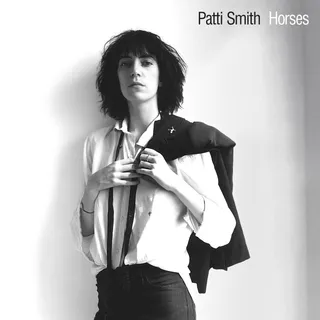
Horses Patti Smith
This essay treats Horses less like a debut album and more like the moment Patti Smith stepped into herself in public. It opens with that now-mythic line—“Jesus died for somebody’s sins, but not mine”—and traces it back to a specific night in 1971, inside St. Mark’s Church, when Smith read poetry with guitarist Lenny Kaye beside her and cracked something open. Poetry stopped behaving. Rock stopped behaving. The distance between artist and audience collapsed.
From there, the piece follows Smith’s escape from South Jersey—away from factory work, strict religion, and narrow expectations—into a New York where she could test who she was allowed to be. She shed organized faith but kept its fire, redirecting belief toward art, imagination, and self-creation. Rock ’n’ roll, to her, wasn’t entertainment or careerism; it was a public service, something raw and democratic that belonged to anyone willing to risk themselves inside it.
Horses comes into focus as the result of that belief. Drawing from Beat poetry, garage rock, free jazz, and sheer nerve, Smith and her band made a record that refused to stay in one shape. Working with John Cale was volatile, but the tension mattered—the album sounds alive because it was fought for. Songs like “Gloria,” “Birdland,” “Land,” and “Free Money” move freely between confession and myth, discipline and chaos. Smith’s voice—sometimes sung, sometimes spoken, sometimes shouted—carries contradictions without trying to smooth them out: tough and tender, profane and reverent, grounded and skyward.
The essay also places Horses at the edge of something just beginning. Punk hadn’t fully named itself yet, but Smith was already living its values: participation over virtuosity, intensity over polish, mistakes as proof that something real is happening. The album didn’t just influence scenes and musicians—it gave permission. It helped move power away from distant idols and back into the hands of listeners, misfits, women, and anyone who felt locked out of rock’s old hierarchies.
What gives this piece its pulse is the way it frames belief as Horses’ central gamble. The album isn’t asking you to convert or agree—it’s asking whether you’re willing to go there with her. That opening line doesn’t reject faith so much as reroute it. Smith isn’t tearing down the sacred; she’s reclaiming it. God becomes imagination. Prayer becomes performance. Salvation becomes self-trust.
Crucially, the essay refuses to turn Patti Smith into a slogan or a punk caricature. Instead, she comes across as a connector—between poetry and rock, women and freedom, the dead and the not-yet-born. The attention to care and community matters: women loving women, sisters protecting sisters, artists handing out keys instead of crowns. Horses wasn’t just loud or new—it quietly rewrote who was allowed to stand at the center of a rock song.
The most lasting idea here is that Horses makes greatness feel reachable. Smith doesn’t promise transcendence through mastery; she offers it through trying, through risk, through showing up imperfect and fully charged. In a culture still addicted to polish and control, that message hasn’t dulled. The album endures not because it’s flawless, but because it insists—again and again—that art is something you step into, something you dare, something you make with your whole life.